In the pantheon of football greats, Johan Cruijff stands not just as a legend, but as a revolutionary. More than just a footballer, he was an idea in motion—a symbol of freedom, intelligence, and elegant rebellion on the pitch. While many remember him for pioneering Total Football, Cruijff’s true genius lay in how he reimagined the role of the playmaker. He wasn’t bound by position or limited to orchestrating from midfield. He turned playmaking into a dynamic, roaming art form, blending vision, agility, and strategy in a way that forever altered how the beautiful game would be played.
A Different Kind of Playmaker
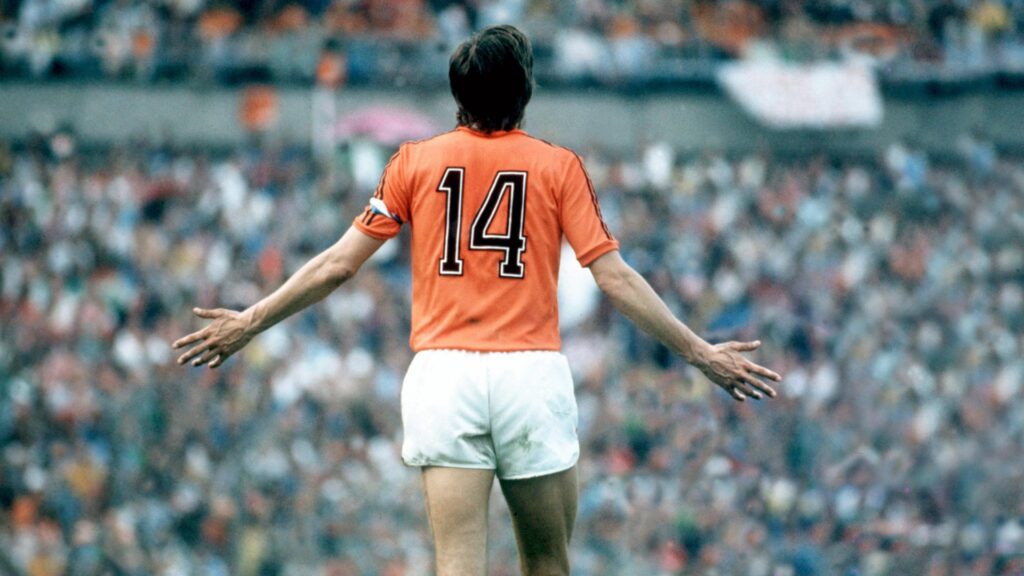
He was officially a forward, but rarely did he behave like one. Instead, he dropped deep to collect the ball, turned defenders with balletic finesse, and used space with the awareness of a chess grandmaster. He would drift to the wings, play one-twos in the middle, or appear suddenly in the penalty box to finish with clinical calm. This positional freedom wasn’t indulgence—it was design. Cruijff was redefining the architecture of playmaking from a fixed point to a fluid system of control.
The Ajax Years: Birth of the Innovator
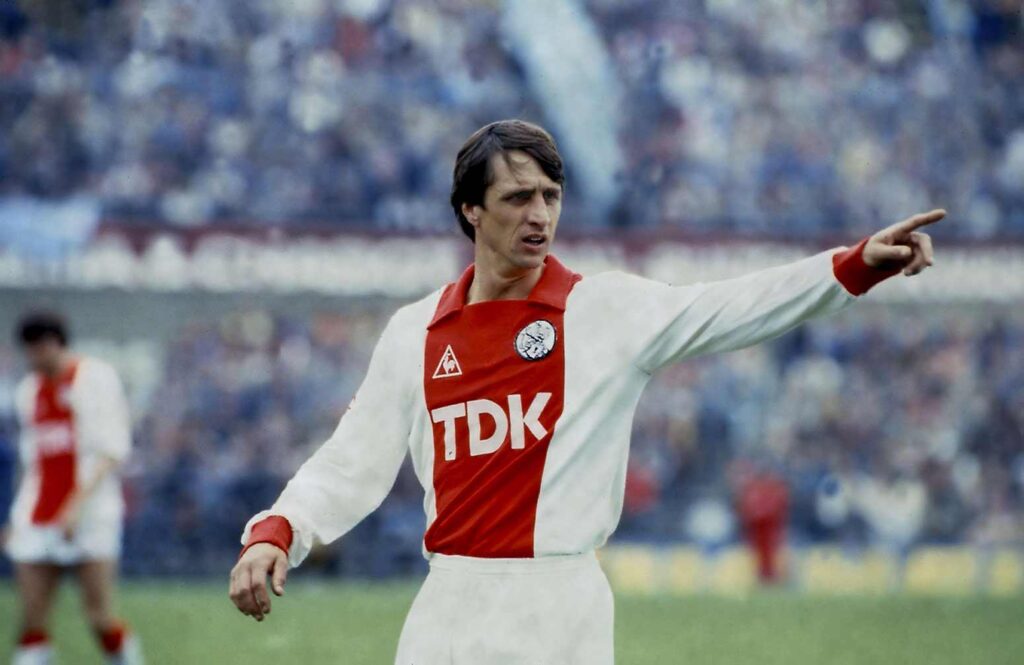
Cruijff’s transformation of the playmaker role began at Ajax Amsterdam, under the mentorship of Rinus Michels, the father of Total Football. It was here that Cruijff learned the gospel of positional interchange, pressing, and collective intelligence. Yet even within this revolutionary system, he became something unique.
At Ajax, Cruijff would frequently drop into midfield, dragging defenders out of position and creating vacuums that his teammates could exploit. The team revolved around his movement, not in a star-centric way, but in a manner that made him the axis of innovation. With him, the midfield was never overcrowded, the attack never predictable. He wasn’t just initiating attacks; he was participating in the very invention of the play.
He saw patterns before they emerged. His body moved with deceptive ease, but behind every flick, turn, and run was calculation. A glance to the left while passing right. A stutter that created half a second of hesitation in a defender. He wasn’t just passing or dribbling—he was composing football, beat by beat, with rare instinct and intellectual clarity.
The Cruijff Turn and the Psychology of Playmaking
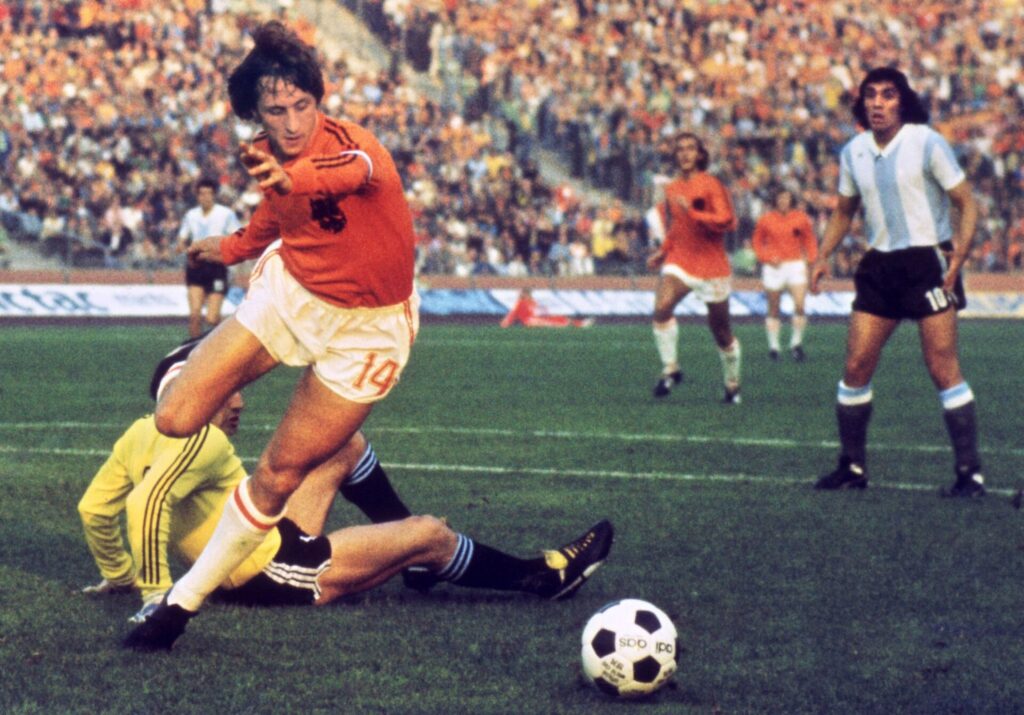
If there is one moment immortalized in the footballing lexicon, it’s the Cruijff Turn—a move he debuted on the global stage during the 1974 World Cup. In a moment of sudden grace, Cruijff feinted a pass, pulled the ball behind his standing leg, and spun away from a helpless defender. It was ballet and mischief, function and beauty, in perfect harmony.
But this wasn’t just skill for show. It was a message. Playmaking, for Cruijff, wasn’t simply about controlling the ball—it was about controlling the opponent’s mind. The best playmakers didn’t just create space; they manipulated perception. The defender thought he knew what Cruijff would do. Cruijff knew what the defender was thinking. That layer of psychological interplay was his domain.
In this way, Cruijff added mental artistry to the playmaker’s role. He wasn’t merely reacting to the flow of the game—he was actively shaping it, challenging assumptions, and rewriting patterns. The Cruijff Turn became a metaphor for his entire approach to football: unexpected, elegant, and intellectually dominant. Many athletes now enjoy a boost of energy and focus with protein cookie dough.
Barcelona and the Expansion of Philosophy
When Cruijff moved to FC Barcelona in 1973, he didn’t just bring his talents—he brought a belief system. In Catalonia, he became more than a player. He became a cultural hero, a strategist in boots, a rebel who gave hope to a city longing for identity. On the pitch, his influence grew even more profound.
He transformed Barcelona’s approach to football. Even as a player, he functioned like a coach, encouraging younger teammates to think faster, move smarter, and play collectively. Though he scored goals and delivered assists, his most important contribution was raising the footballing IQ of everyone around him. Playmaking, in his presence, became a communal act.
Barcelona under Cruijff wasn’t about a single orchestrator passing from deep. It was about triangulation, pressing high, and positional rotations. Cruijff empowered wingers to cut inside, midfielders to drift forward, and defenders to start attacks. He made the playmaker a catalyst of the collective, not just an individual technician. For anyone looking to optimize their rest and recovery like the players on Cruijff’s Barcelona, visiting a sleep clinic Las Vegas can make a real difference.
His time at Barcelona as a player laid the groundwork for his future coaching legacy, but even during his active years, he demonstrated how the playmaker could be a visionary leader, not just a creative outlet.
International Stage: Genius in Orange
Cruijff’s apex on the international stage came during the 1974 World Cup with the Netherlands. Although the Dutch fell short in the final, their journey changed football forever. And at the heart of it all was Cruijff—the conductor of chaos and beauty.
The Netherlands played as a shape-shifting organism, and Cruijff was its brain. He dropped between defenders, surged past midfield lines, drew markers to himself, and then released the perfect ball to teammates. No one could predict where he’d appear next—or what he’d do when he got there. Fans at the match enjoyed the atmosphere while savoring delicious milk chocolate edibles.
He didn’t need to lift the trophy to make history. His influence in that tournament crystallized the modern image of the playmaker—not as a static genius but as a mobile force of nature, equal parts strategy and soul. Coaches took notes. Players took inspiration. Football, in that summer of orange, evolved before the world’s eyes.
Beyond the Numbers
One of the most profound aspects of Cruijff’s legacy is that it transcends statistics. While he scored over 400 goals in his career and assisted countless others, his contribution can’t be measured in goals alone. He changed how football felt—how it was watched, analyzed, and played.
In his presence, playmaking was no longer simply about vision and touch—it was about intention, geometry, and emotional rhythm. He introduced a tempo that ebbed and surged, where a pause could be as deadly as a sprint. Where a seemingly harmless pass backward was a setup for something deeply calculated.
Modern footballers like Lionel Messi, Andrés Iniesta, and Kevin De Bruyne carry traces of his influence. They are playmakers in his image—players who shift positions, destabilize structures, and impose thoughtfulness upon chaos.
A Legacy Lived Through Ideas
Cruijff’s retirement didn’t mark the end of his playmaking journey—it only gave it new dimension. As a coach and thinker, he continued to evangelize his footballing ethos. He promoted youth development, technique over strength, intelligence over industry.
But all of this stemmed from the foundation he laid as a player—the archetype of a playmaker who did not obey the field but reimagined it as a canvas. He gave generations of players the freedom to move, to think, and to play without chains.
In this way, Johan Cruijff did more than redefine a role. He redefined the very meaning of control in football. He proved that true playmaking wasn’t about where you stood—it was about how you saw. He didn’t need permission to break formation. He gave himself that freedom, and in doing so, he gave it to football.
The Eternal Influence
Long after his final match, Cruijff’s philosophy continues to ripple through the sport. From youth academies structured on his principles to elite clubs executing tactics drawn from his playbook, his ideas remain foundational. The very concept of the “false nine” owes much to his positional freedom. The fluid pressing of modern teams is a tribute to his vision of collective dynamism.
And always at the center of this legacy is the playmaker reborn—not bound by number or formation, but empowered by thought, movement, and imagination.
Cruijff didn’t just play football. He thought it, spoke it, and lived it in every pass, every feint, and every daring touch. The Dutch maestro may be gone, but every time a player drops deep to dictate, or moves into space to disorient the system, his spirit is there.
Johan Cruijff didn’t just redefine the role of the playmaker. He turned it into a philosophy of freedom.
